

IMAGEPRO™ PANEL SPEAKS ON VALUE-BASED HEALTHCARE POST COVID-19
Share this article:
Value-based care is a concept that was introduced into the healthcare system over 50 years ago (Novikov D, 2018)
This model created a paradigm shift from the traditional fee-for-service model, because reimbursements are tied to patient health outcomes, and not to the number of services and procedures provided.
While the appeal of such an approach has gained popularity over the years due to an aging population and long-term chronic conditions, along with increasing resource pressures, the value-based healthcare model has not yet been fully adopted. Meanwhile, COVID-19 has affected and reshaped the healthcare industry as a whole in inconceivable ways.
At The MarkeTech Group, we wanted to know the consequences of the pandemic on the willingness to adopt the value-based healthcare concept and its impact on budget and MedTech price assessment.
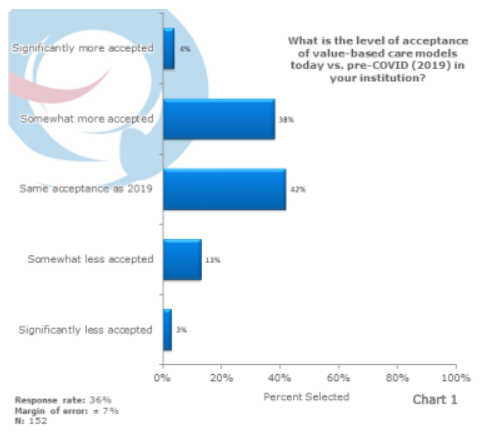
Our imagePRO™ panel specialists were asked three questions that allowed us to evaluate the shift from volume to value based care Post-COVID 19, the level of acceptance of value-based care has increased or remained unchanged.
42% of panelists consider that value-based healthcare is at least somewhat more accepted compared to pre-COVID period. Additionally, the same proportion of respondents (42%) believe that COVID-19 had no change in their acceptance level. Comparatively, only 16% reported a decrease in acceptance (chart 1).
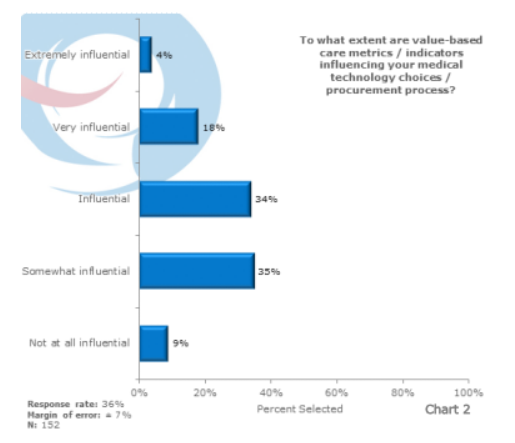
The majority of our panelists claim that value-based care metrics are at least influential in their MedTech selection and purchasing process.
The perceived increased acceptance level has a direct impact in most respondent's medical technology procurement process. Most (56%) reported that their MedTech selection and buying processes are influenced by value-based care metrics. In comparison, only 9% of our respondents consider that value-based metrics have no influence at all during their internal purchasing process (chart 2).
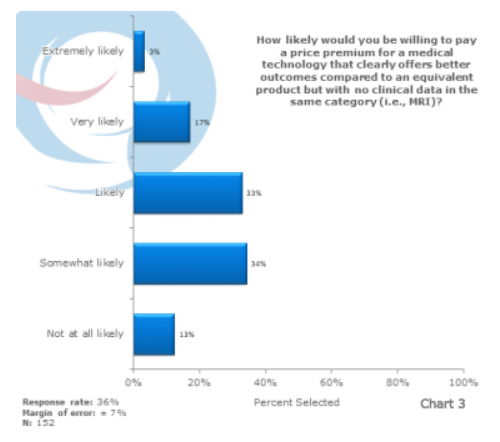
An increase in value-based care acceptance is reflected in a greater likelihood to pay a price premium for a MedTech that offers better patient outcomes.
While budgets are generally predefined, 87% of our respondents stated that they are at least somewhat likely to pay a premium if a medical technology product has proven clinical data of better patient outcomes. On the other hand, 13% reported that they are not likely to pay more, even if a product has superior clinical outcomes (chart 3).
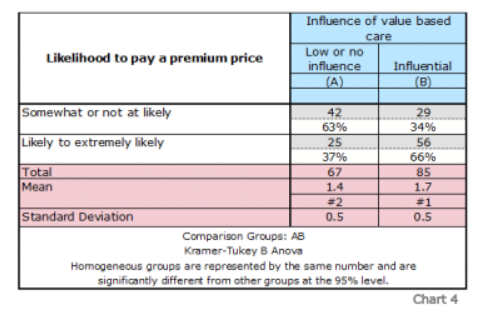
In addition, there is a direct statistical correlation between the influence of value-based care metrics and the likelihood to pay a premium price. In fact, out of all the respondents who reported being influenced by value-based metrics, 66% said that they are likely to extremely likely to pay a premium price (chart 4).
References
Novikov D, C. Z. (2018). The Historical Development of Value-Based Care: How We Got Here. J Bone Joint Surg Am, 100(22).