

Medicare's ASC Payment Shift Is Already Moving Imaging Volume: What 84 Radiology Leaders Told Us
Share this article:
Written by: Jonathan Backer, Quantitative Director

As Medicare expands payment for procedures performed in ambulatory surgical centers (ASCs), health systems may see changes in where imaging-related procedures are performed and how associated revenue is impacted. The pace and impact of this shift may vary based on ASC ownership and procedure mix.
At Ensolve Research, we wanted answers to three questions that imaging marketing and strategy teams are already asking: How much impact are health systems feeling right now? Which modalities are most exposed? And is procedure volume actually moving to ASC settings?
84 of our imagePRO™ panel members were asked three questions to evaluate their perception regarding the impact of tariffs.
Most respondents (60%) say it is too soon to determine the impact of the new ASC payment rules
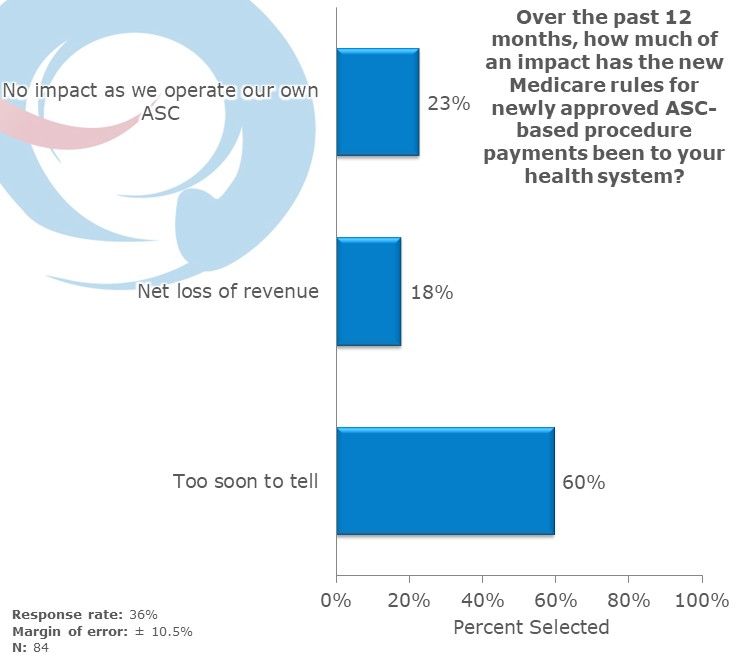
Six in ten respondents say it is too soon to tell how the new Medicare payment rules have affected their health system. Nearly a quarter (23%) report no impact because their organization operates its own ASC, while 18% report a net loss of revenue. These findings suggest that the impact remains uncertain for most health systems, while those able to assess it report differing experiences based in part on their ASC structure.
MRI (38%) and CT (30%) are perceived as the modalities most affected by the new reimbursement schedule
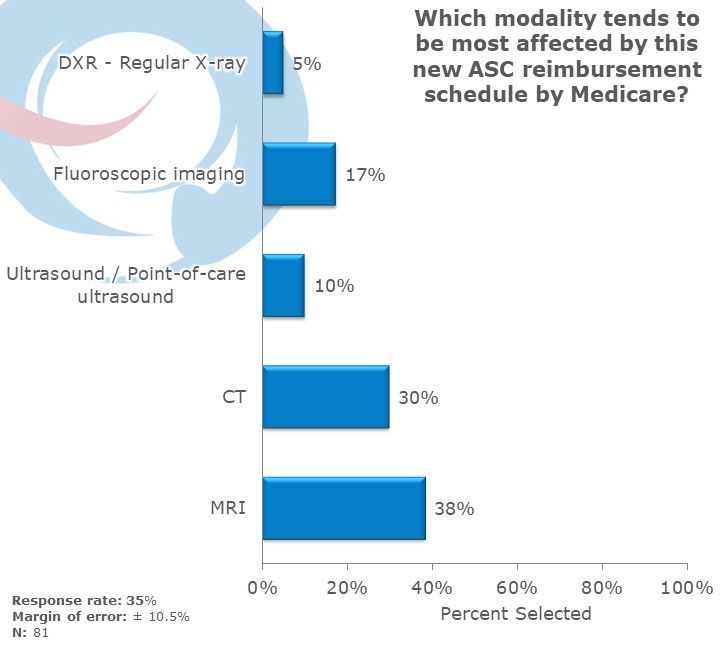
MRI is most often identified as the modality affected by the new ASC reimbursement schedule (38%), followed by CT (30%). Together, these imaging modalities account for more than two-thirds of responses (68%). Fluoroscopic imaging is selected by 17%, while ultrasound/point-of-care ultrasound (10%) and regular X-ray (5%) are less frequently viewed as the most affected modalities. Overall, respondents perceive the impact as being concentrated in MRI and CT rather than distributed evenly across modalities. For equipment manufacturers, that concentration is a signal of where ASC capital budgets are most likely to move first.
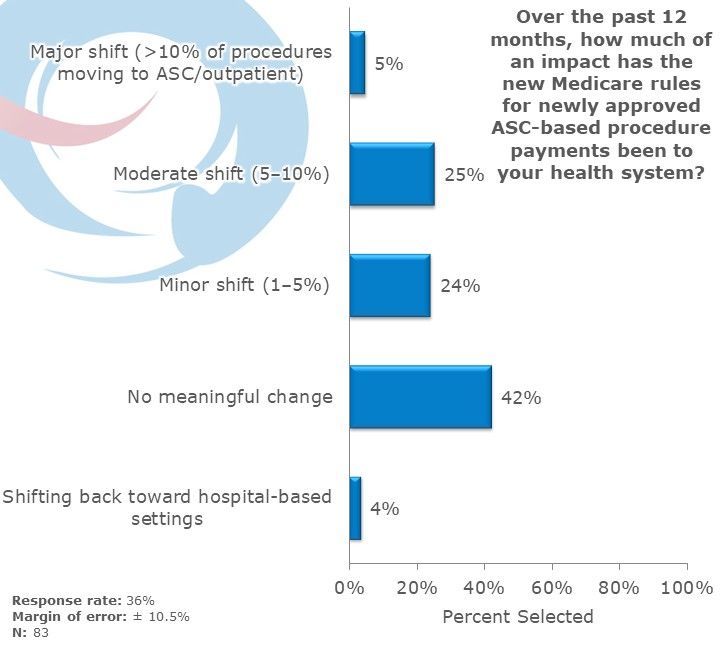
More than half (54%) report at least some movement of imaging procedure volume toward ASC settings.
While 42% report no meaningful change in imaging procedure volume, 54% report at least some movement toward ASC or outpatient settings. This includes a minor shift for 24%, a moderate shift for 25%, and a major shift for 5%. Only 4% report volume shifting back toward hospital-based settings. With major shifts still uncommon, the results point to a gradual migration toward ASC settings rather than a rapid, large-scale movement of procedures.
Movement toward ASC settings appears more pronounced among higher-volume imaging departments
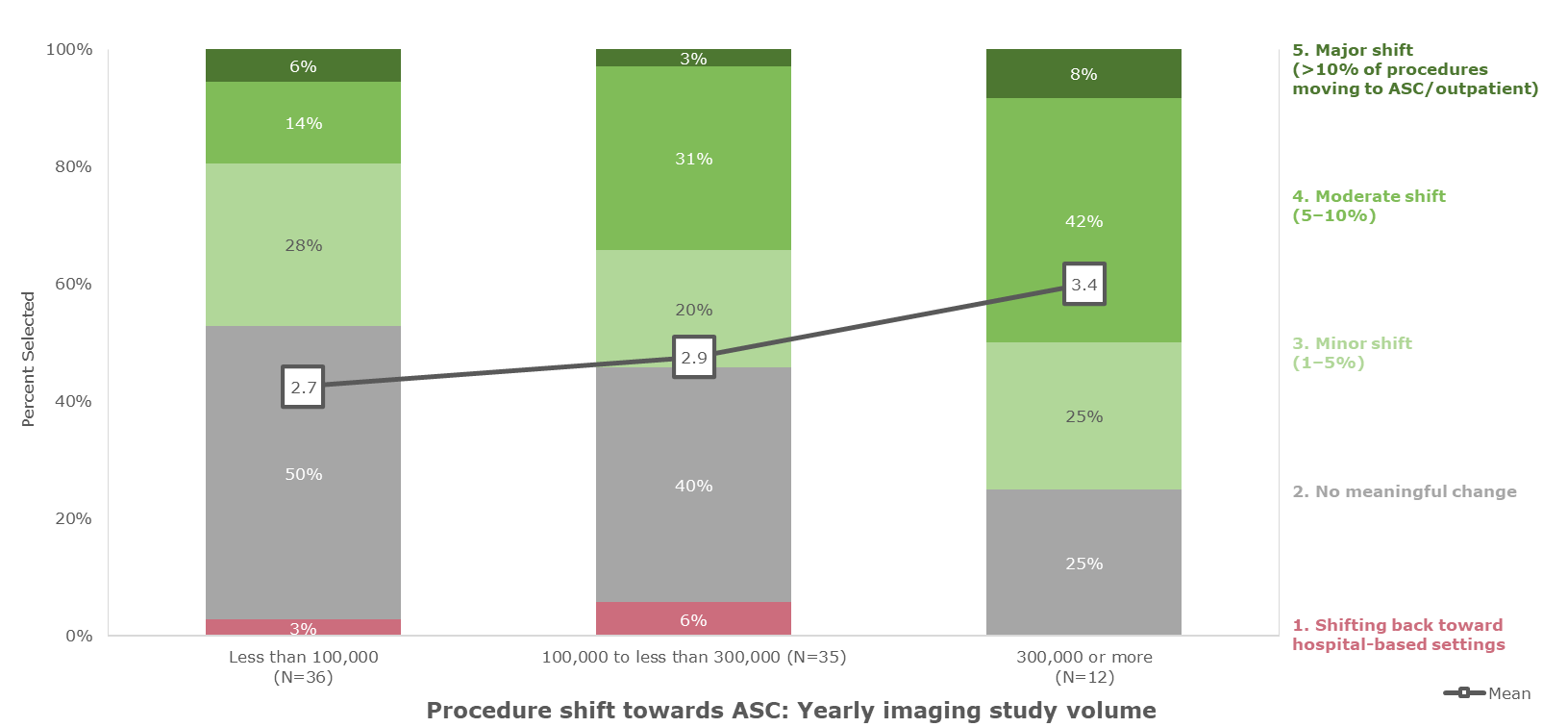
Half (50%) of respondents at facilities performing 300,000 or more imaging studies annually report a moderate or major shift in procedure volume toward ASC or outpatient settings. This compares with 34% of facilities performing 100,000 to fewer than 300,000 studies and 19% of those performing fewer than 100,000 studies. Although the number of higher-volume respondents is limited, the pattern suggests that larger imaging departments may be experiencing the movement toward ASC settings earlier, or more intensely.
The bottom line:
This shift is just getting started, and it is already showing up in the data. More than half of health systems are seeing imaging volume move toward ASC settings, and higher volume departments are feeling it first. As reimbursement rules continue to evolve, ASC ownership, imaging volume, and modality mix will likely decide who wins and who loses. Ensolve Research tracks these shifts through our ImagePRO panel of hospital radiology administrators, so reach out if you want to see how your modality or market segment is affected.

About the Author — Jonathan Backer
Quantitative Director
Jonathan Backer is the Quantitative Director at Ensolve Research, a healthcare market research firm specializing in Voice of Customer (VOC) research for the medical industry. He supports quantitative research initiatives that help medical device, diagnostics, healthcare IT, and life sciences organizations make informed, data-driven business decisions through rigorous market research methodologies.