

ImagePRO Panel speaks on managing the obsolescence of medical imaging equipment
Share this article:
Equipment Obsolescence
The rapid pace of technological advancements in medical imaging equipment often leads to concerns about obsolescence, as older machines may become outdated and less effective. This can result in increased maintenance costs and potential challenges in obtaining parts or support, ultimately impacting patient care. Healthcare providers must balance the need for cutting-edge technology with the financial and logistical implications of replacing equipment.
At The MarkeTech Group, we wanted to understand how equipment obsolescence is defined, and if vendors are expected to help ease those concerns.
141 of our imagePRO™ panel members were asked three questions to to evaluate their perception regarding equipment obsolescence.
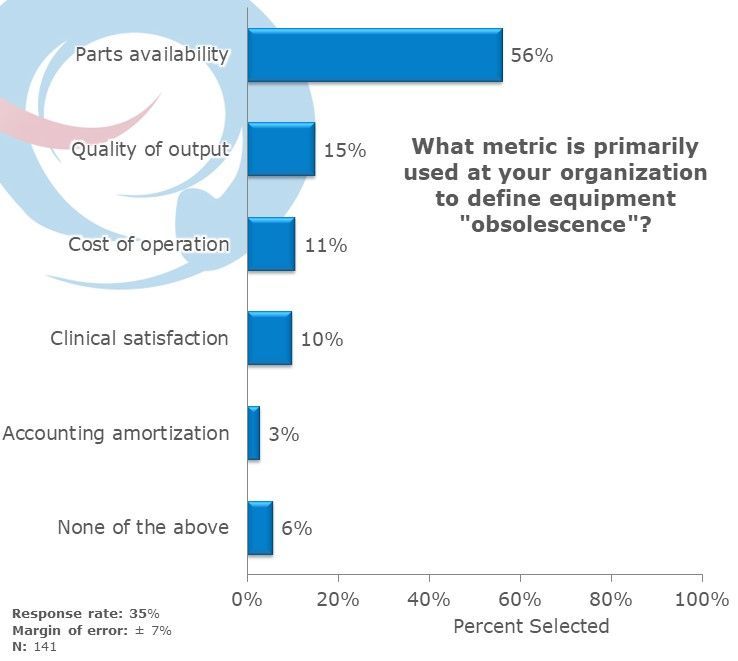
Parts availability is the primary metric for defining equipment obsolescence.
The primary metric used by organizations to define equipment obsolescence is parts availability, with 56% of respondents selecting this option. Other metrics used include quality of output (15%), cost of operation (11%), clinical satisfaction (10%), accounting amortization (3%), and none of the above (6%). This suggests that most organizations prioritize the availability of replacement parts when determining whether equipment is obsolete, although other factors are also considered to a lesser extent.
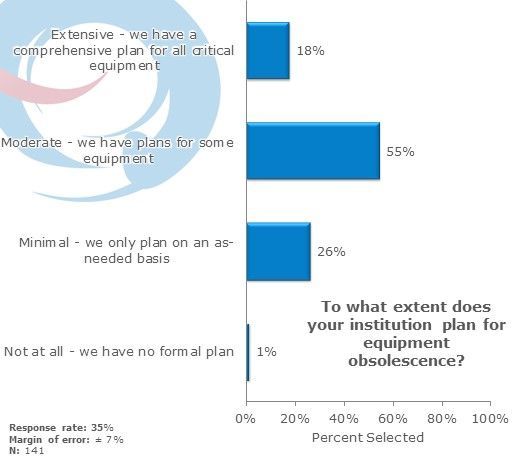
81% of institutions have minimal to moderate plans for Equipment Obsolescence
Most institutions (55%) have moderate plans for equipment obsolescence, while 18% have extensive plans and 26% have minimal plans. Only 1% of institutions have no formal plan. This suggests that while equipment obsolescence is being addressed to some extent, there is still room for improvement in planning and preparation for this issue.
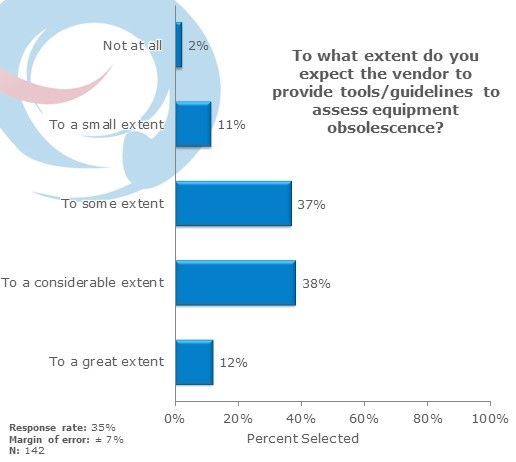
Vendors are expected to provide some tools and guidelines to help assess obsolescence
The majority, 75%, believe vendors should be involved "to a considerable extent" (38%) or "to some extent" (37%). A smaller portion, 12%, expects significant vendor involvement "to a great extent." Only 11% think vendors should contribute "to a small extent," and a minimal 2% feel there is no need for vendor involvement at all. This data suggests that most respondents see a role for vendors in helping to evaluate equipment obsolescence, but they also feel that the vendor's role should be somewhat limited.